Introduction
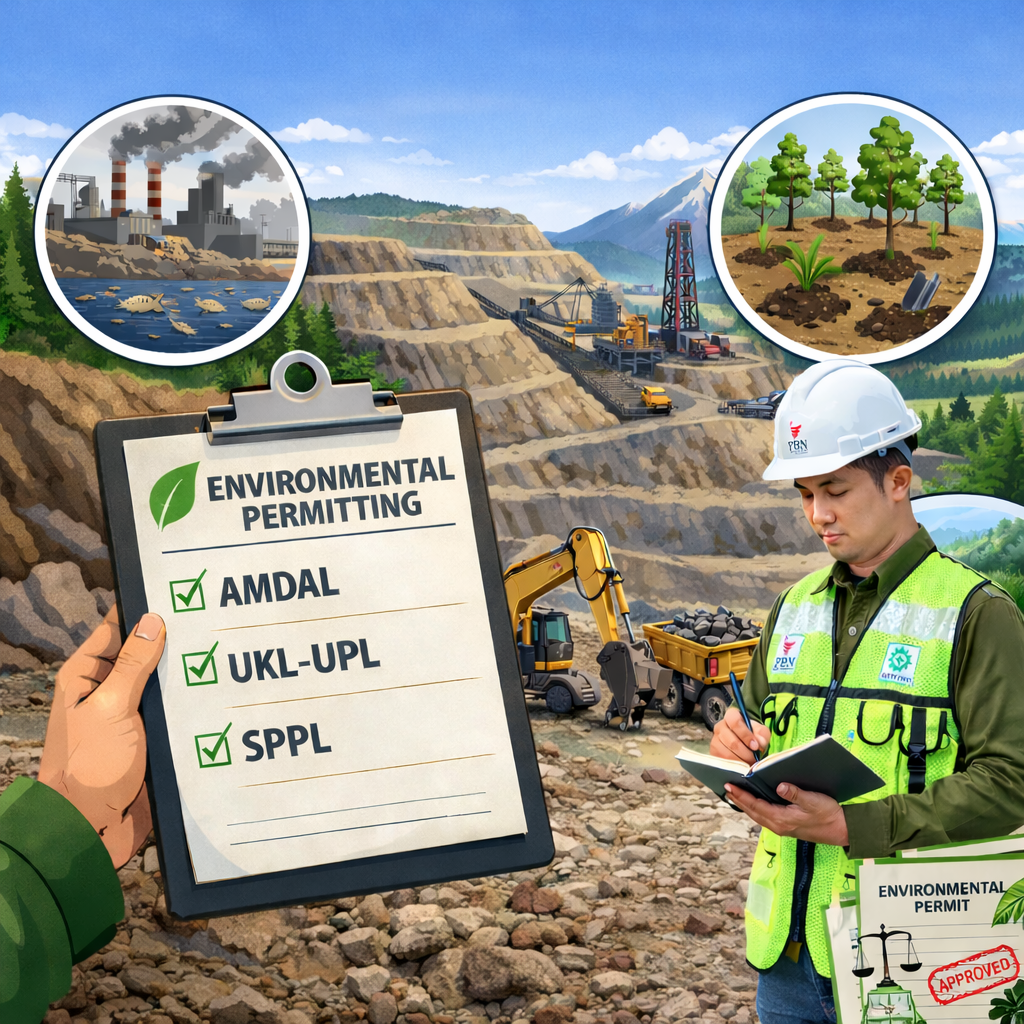
The mining sector plays a strategic role in Indonesia’s economic development by providing essential raw materials for energy, infrastructure, and industrial growth. However, mining activities also pose significant environmental and social risks, including land degradation, water pollution, deforestation, and community impacts. To ensure that mining development is conducted responsibly and sustainably, the Government of Indonesia requires mining projects to comply with environmental permitting instruments, namely the Environmental Impact Assessment (AMDAL), Environmental Management and Monitoring Efforts (UKL-UPL), and the Statement of Environmental Management Capability (SPPL).
These instruments function as preventive and control mechanisms to assess potential environmental impacts, establish mitigation measures, and ensure continuous monitoring throughout the mining lifecycle.
Environmental Risks in Mining Activities
Mining operations involve multiple stages, each with distinct environmental impacts:
- Exploration Stage: Land clearing, drilling activities, noise, and potential contamination from drilling fluids.
- Construction Stage: Infrastructure development, increased sedimentation, and disturbance to local ecosystems.
- Operation and Production Stage: Waste rock generation, tailings management, air emissions, acid mine drainage, and water consumption.
- Mine Closure and Post-Mining Stage: Land instability, residual contamination, and long-term environmental risks if reclamation is inadequate.
Given these potential impacts, environmental assessment and management are critical components of mining project planning and execution.
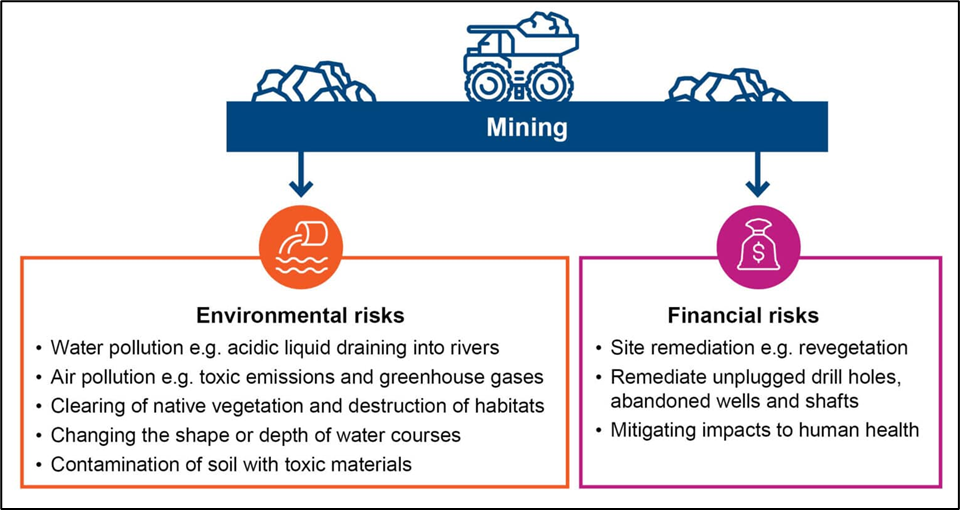
(Source: Office of the Auditor General)
Application of AMDAL in the Mining Sector
AMDAL is mandatory for mining activities that are likely to generate significant environmental impacts, particularly large-scale mining operations. In the mining context, AMDAL evaluates:
- Changes in land use and landscape morphology
- Impacts on surface water and groundwater quality
- Biodiversity loss and habitat fragmentation
- Air quality and noise impacts
- Social and economic effects on surrounding communities
The AMDAL process includes public consultation, expert review, and technical evaluation to ensure that environmental risks are identified early and managed appropriately. The resulting Environmental Management Plan (RKL) and Environmental Monitoring Plan (RPL) become binding obligations for mining companies.
Role of UKL-UPL in Mining Activities
UKL-UPL applies to mining-related activities with moderate environmental impacts, such as small to medium-scale mining operations or supporting facilities. The UKL-UPL document focuses on practical mitigation measures, including:
- Management of runoff and sedimentation
- Control of dust and noise
- Proper storage and handling of hazardous materials
- Routine environmental monitoring
UKL-UPL serves as an operational environmental management tool that supports regulatory compliance without the complexity of a full AMDAL study.
SPPL for Low-Risk Mining Activities
SPPL is applicable to low-risk mining-related activities, such as small-scale operations or non-intrusive supporting activities. Through SPPL, mining operators formally commit to implementing basic environmental management measures and complying with environmental standards.
Although simpler in scope, SPPL remains an important instrument for promoting environmental responsibility among small-scale mining actors.
Regulatory Developments and Risk-Based Licensing
The implementation of the Online Single Submission – Risk Based Approach (OSS-RBA) has restructured environmental permitting in the mining sector. Under this system, the requirement for AMDAL, UKL-UPL, or SPPL is determined by the level of environmental risk associated with the mining activity. This approach aims to streamline licensing processes while maintaining environmental protection standards.
Challenges in Environmental Management of Mining Activities
Despite regulatory frameworks, mining projects face several challenges:
- Complexity of environmental impacts across the mining lifecycle
- High costs of environmental management, monitoring, and reclamation
- Limited technical capacity in remote mining areas
- Community concerns related to land access, water resources, and livelihoods
Addressing these challenges requires strong environmental governance, adequate technical expertise, and effective stakeholder engagement.
Environmental Compliance and Sustainable Mining
Compliance with AMDAL, UKL-UPL, and SPPL contributes to sustainable mining by:
- Reducing environmental degradation and pollution
- Enhancing transparency and accountability
- Minimizing conflicts with local communities
- Supporting mine reclamation and post-mining land use planning
Environmental compliance should be viewed not merely as a regulatory obligation but as an integral part of responsible mining practices.
Conclusion
AMDAL, UKL-UPL, and SPPL are essential environmental instruments in managing the impacts of mining activities in Indonesia. Their effective implementation ensures that mining development aligns with environmental protection objectives and sustainable development principles. Strengthening enforcement, improving technical capacity, and integrating environmental considerations throughout the mining lifecycle are crucial for achieving long-term sustainability in the mining sector.
References
Republic of Indonesia. (2009). Law No. 32 of 2009 on Environmental Protection and Management.
Republic of Indonesia. (2021). Government Regulation No. 22 of 2021 on Environmental Protection and Management.
Ministry of Energy and Mineral Resources (ESDM). (2018). Guidelines on Mining Environmental Management.
Ministry of Environment and Forestry (KLHK). (2021). Environmental Approval Procedures.